
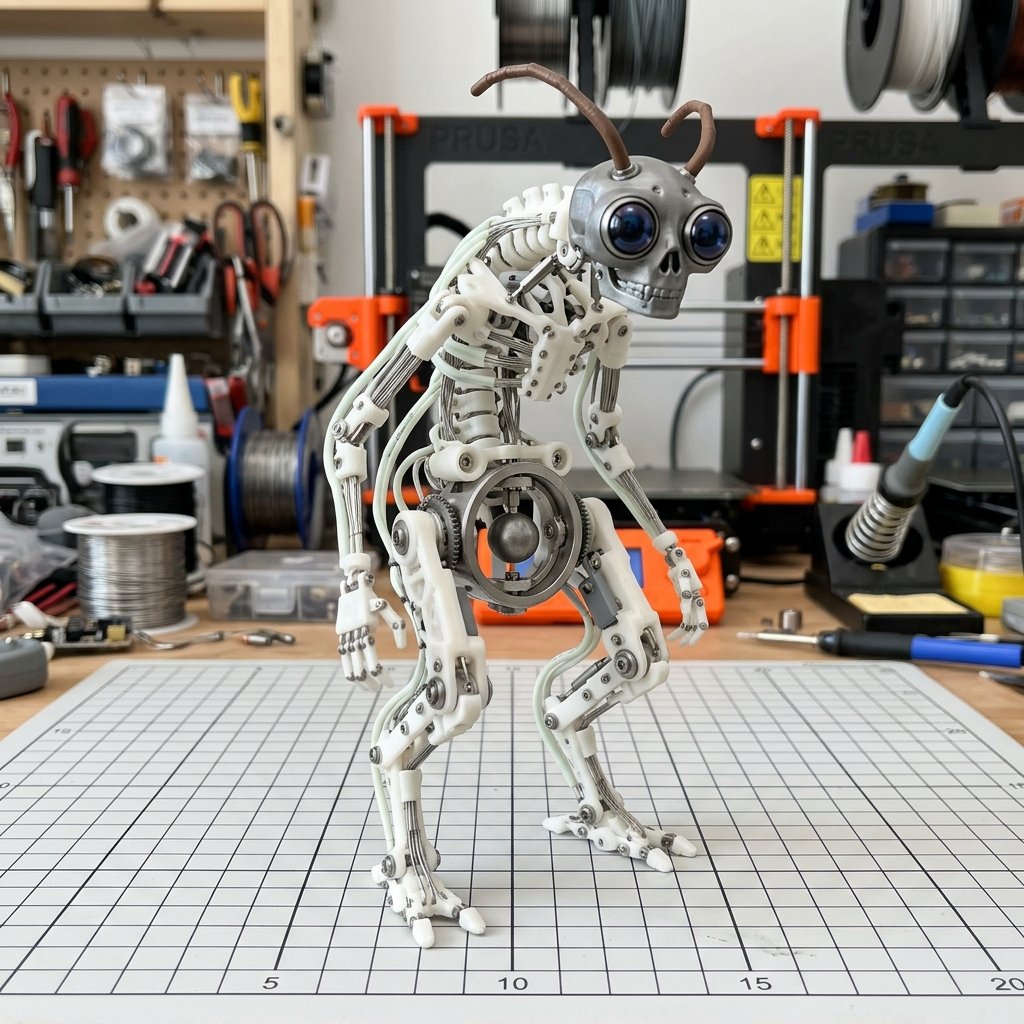
Complete technical dossier of the autonomous companion micro-robot. Biomechanical architecture, advanced materials, passive walking kinematics, and engineering concept arts.
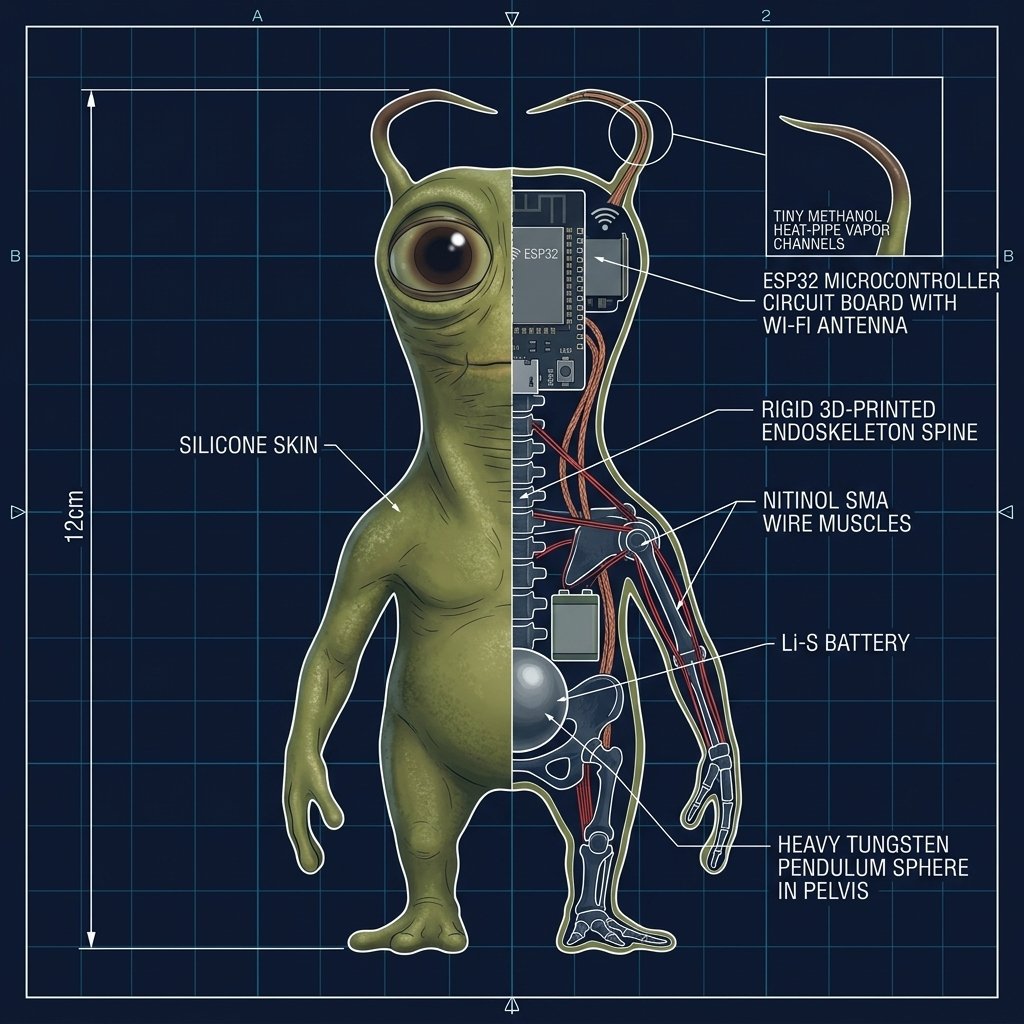
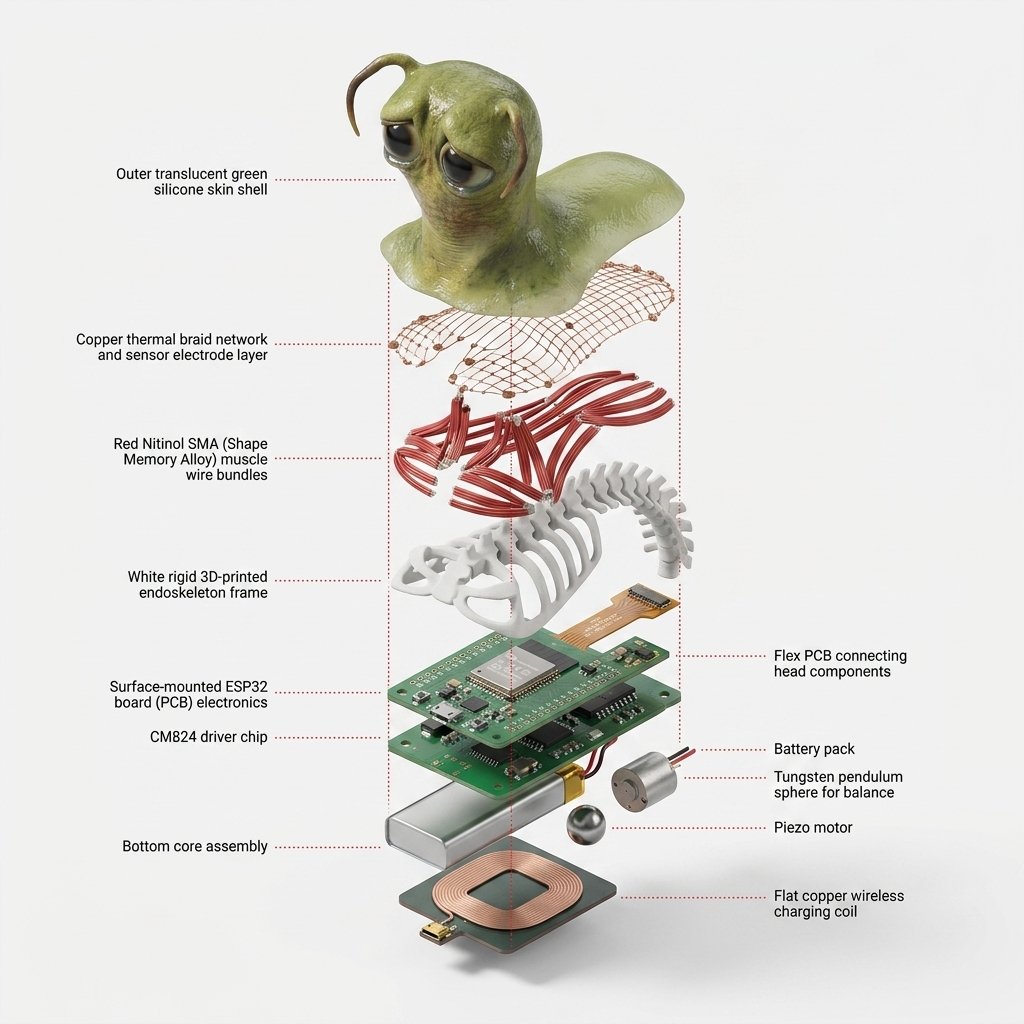
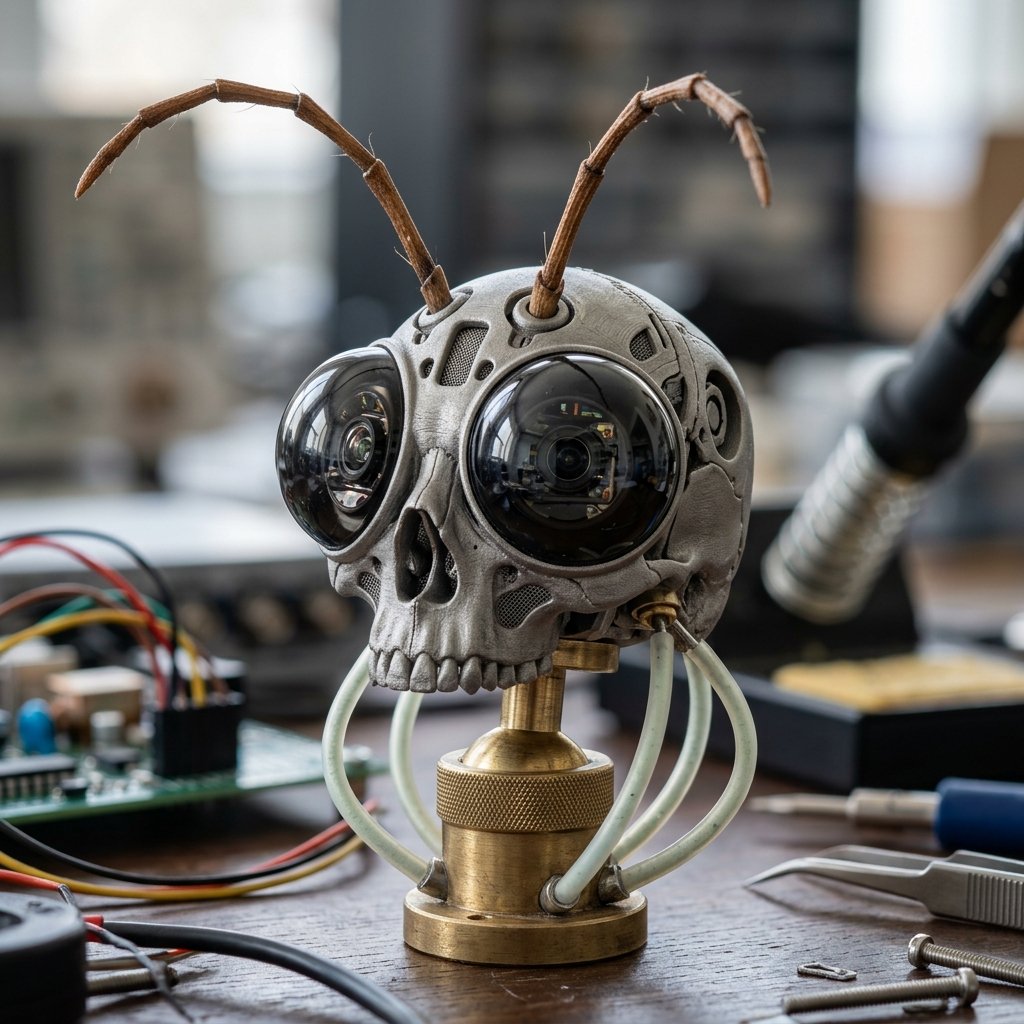
Max is a 12 cm autonomous companion micro-robot with the appearance of a round and pudgy olive-green organic creature, with large bulbous black eyes and two thin curved antennae. Beneath its silicone skin lies a 3D-printed endoskeleton, Nitinol artificial muscles, and remote intelligence.
Hunched posture, passive pendular gait, facial micro-expressions. Every movement is designed to look natural and alive, not mechanical.
The onboard ESP32-S3 manages local perception and reflexes. Complex reasoning is offloaded to a server via Wi-Fi — the 'Symbiotic Host' architecture.
No geared motors. All movements are produced by artificial muscles (Nitinol, LCE) and a piezoelectric motor — zero audible mechanical noise.
In case of danger or pressure > 45N, the ER fluid solidifies, the muscles relax, and Max "goes limp" — mimicking an animal playing dead.
Li-S 1200 mAh battery rechargeable par induction Qi. Max revient instinctivement vers son « nid » de recharge quand l'énergie est basse.
16 electrodes in the silicone skin allow touch detection all over the body with a 2-3 mm resolution. Max 'feels' when it is petted.
Six AI-generated technical illustrations, from engineering blueprints to cinematic portraits, covering every angle of Max.
Endoskeleton, Nitinol muscles, battery, ESP32-S3
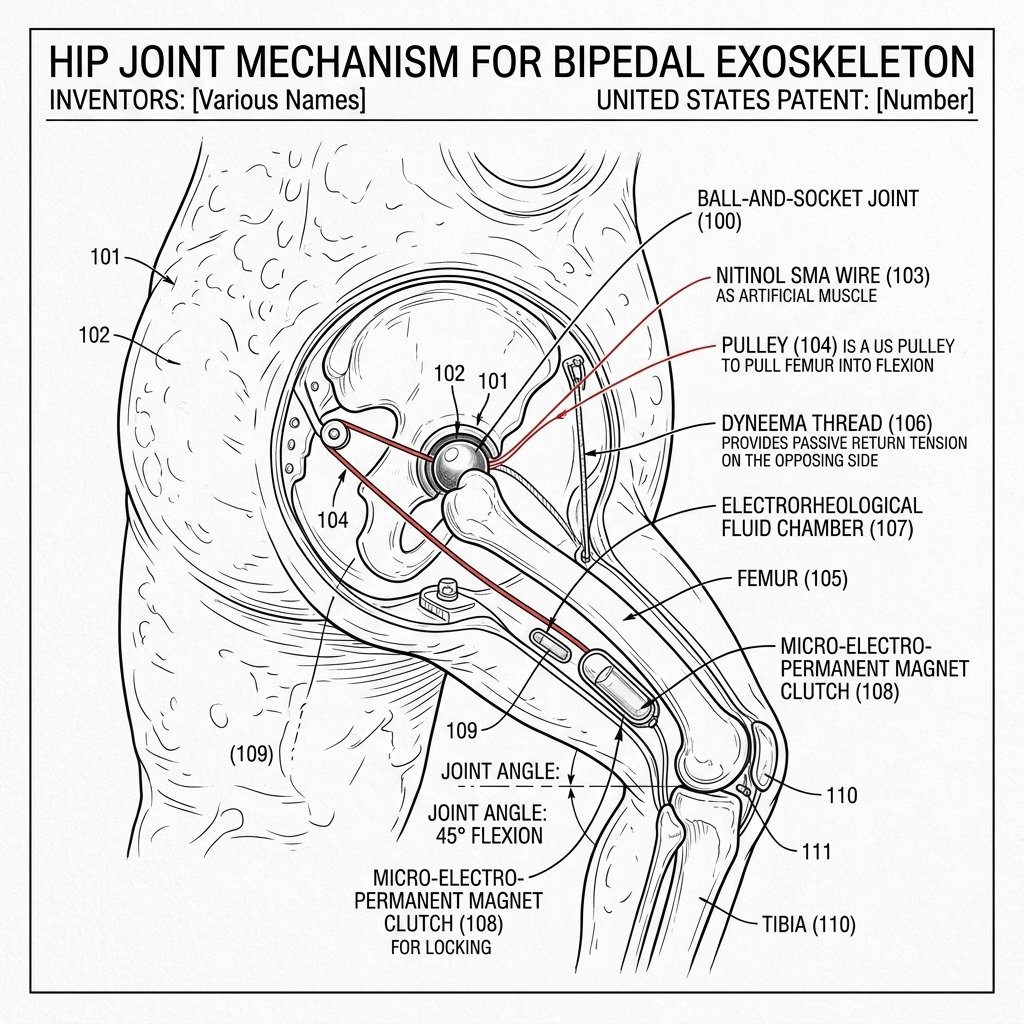
Ball-joint, Nitinol, Dyneema, MEP — patent style
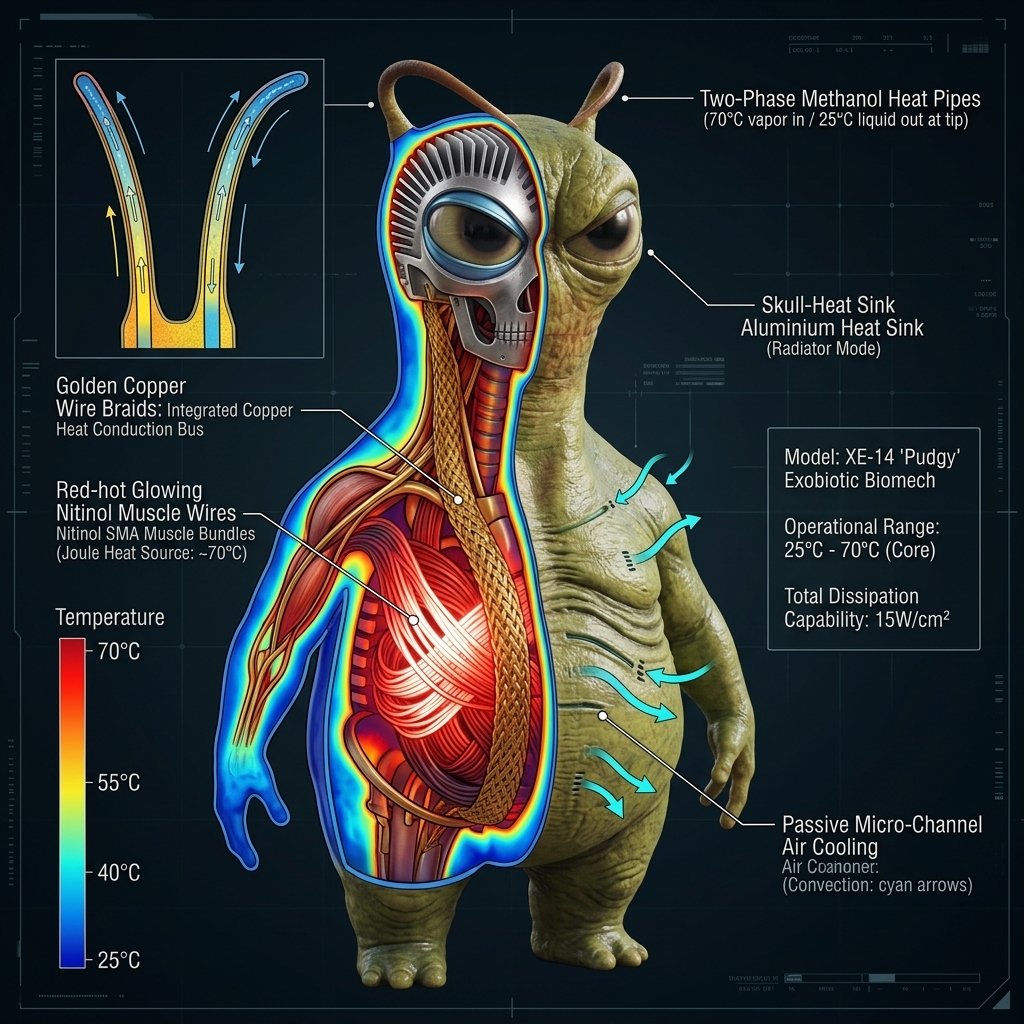
Gradient 70°C → 25°C: muscles → copper → antennae
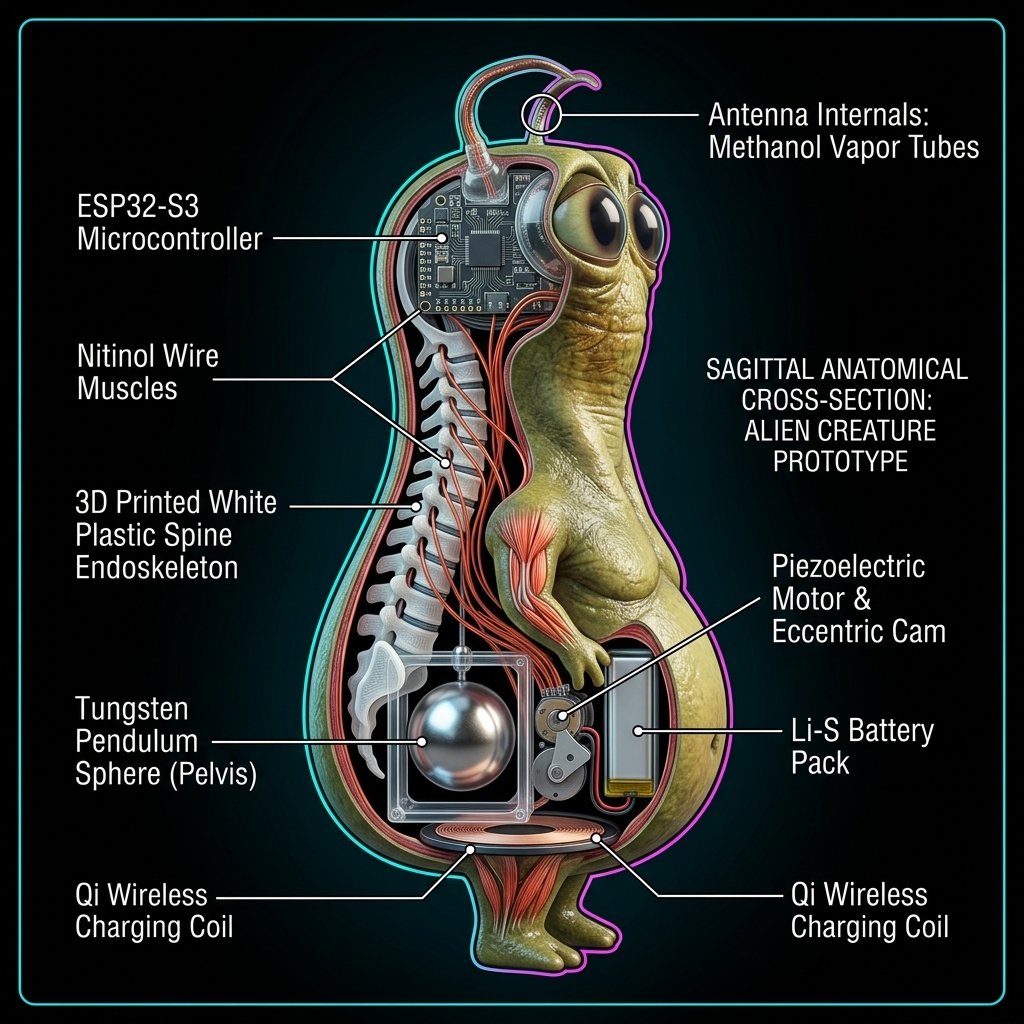
Hunched posture, tungsten pendulum, piezo motor
6 sub-assemblies: head, neck, trunk, pelvis, legs
Living Max: CMOS eyes, articulated antennae, amber skin
Titanium skull, 25µm conjugate mobile eyes, h-BN helical neck
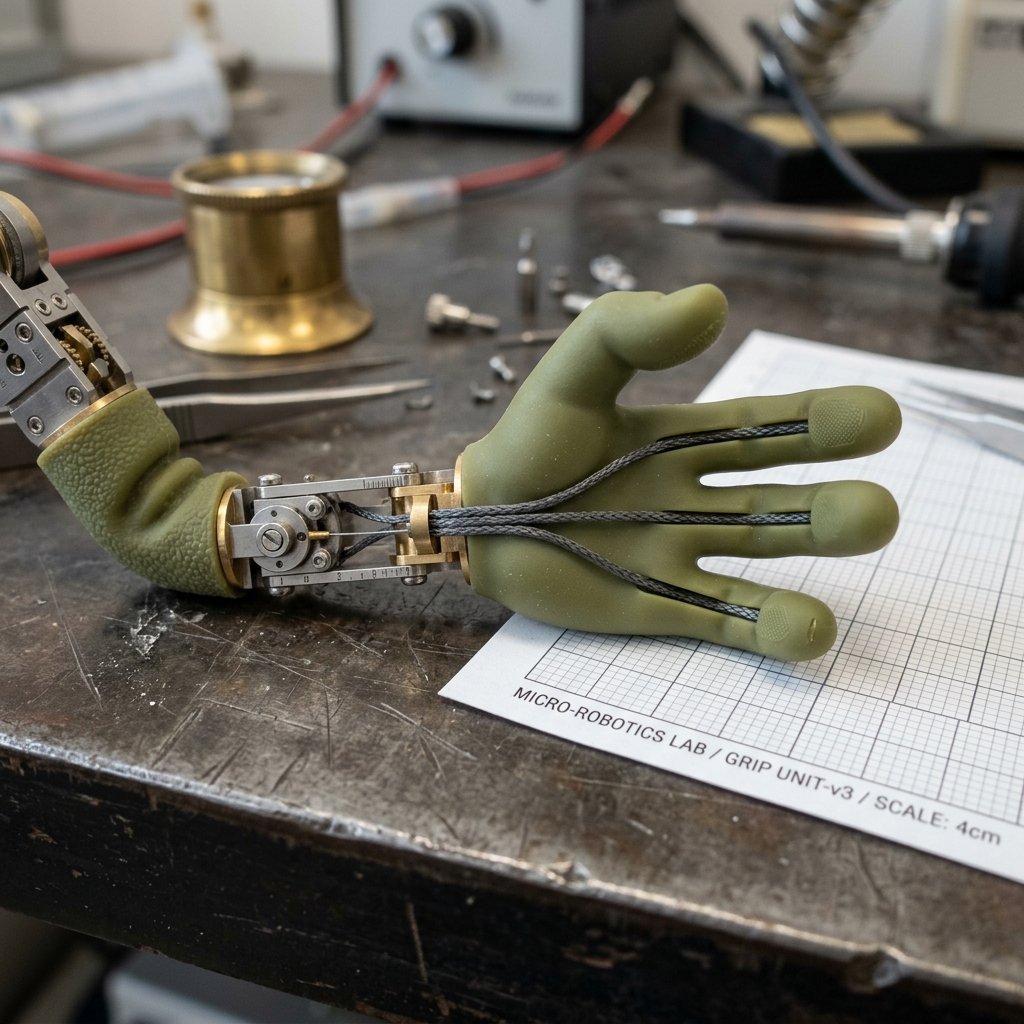
Underactuated 3-finger hand, Dyneema tendon, 50µm Nitinol muscle
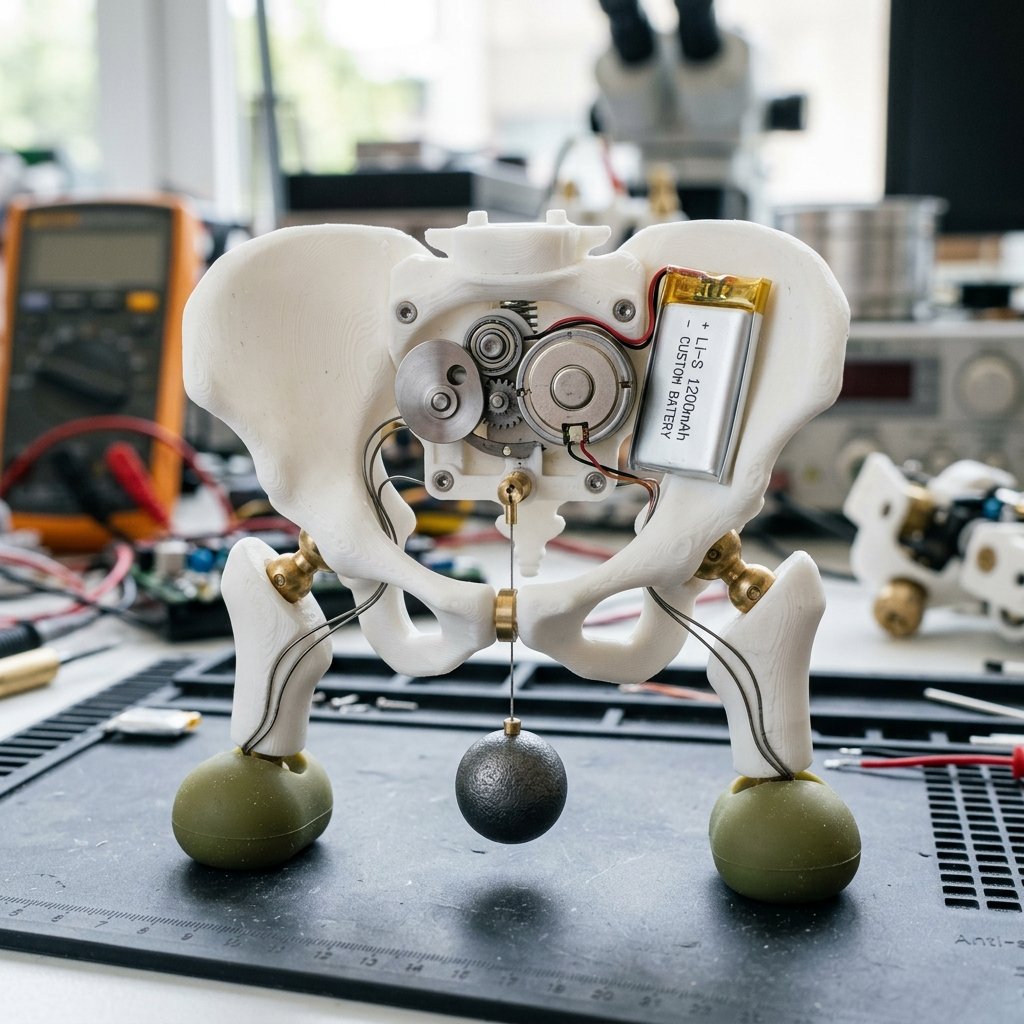
Piezo cam, rotary motor, 15g tungsten pendulum, silicone legs
Hunched PLA structure, titanium skull, Nitinol muscles, and h-BN sheaths
Beneath its round and pudgy olive-green creature appearance, Max is built in concentric layers, from the central rigid endoskeleton to the tactile skin on the surface.
Max uses a hybrid architecture combining 6 different actuation technologies, each optimized for a specific type of motion.
| Technology | Force | Speed | Silence | Energy | Mass | Heat | Max Application |
|---|---|---|---|---|---|---|---|
| Nitinol SMA (50µm) | ★★★★★ | ★★☆☆☆ | ★★★★★ | ★☆☆☆☆ | ★★★★☆ | ★☆☆☆☆ | Main muscles |
| SMA Bimorph (10mg) | ★★★☆☆ | ★★★☆☆ | ★★★★★ | ★★☆☆☆ | ★★★★★ | ★★☆☆☆ | Micro-expressions |
| LCE (Élastomère LC) | ★★☆☆☆ | ★☆☆☆☆ | ★★★★★ | ★★☆☆☆ | ★★★★★ | ★★☆☆☆ | Simulated breathing |
| MSMA (Magnétique) | ★★★☆☆ | ★★★★★ | ★★★★☆ | ★★★☆☆ | ★★★☆☆ | ★★★★★ | Antennae (>50 Hz) |
| DEA (Diélectrique) | ★★☆☆☆ | ★★★★★ | ★★★★★ | ★★★★☆ | ★★★★★ | ★★★★★ | Skin twitching |
| Piézo Rotatif | ★★★★☆ | ★★★★☆ | ★★★★★ | ★★★★★ | ★★★☆☆ | ★★★★★ | Walking motor |
| Fluide ER | N/A (blocage) | ★★★★★ | ★★★★★ | ★★★★☆ | ★★☆☆☆ | ★★★★★ | PAD locking |
Boron Nitride (h-BN) loaded silicone is a safe and viable alternative to LMPE. Fully electrically insulating (zero risk of short circuit) and inert (no copper corrosion), it offers excellent thermal conductivity of 1.5 to 3 W/m·K.
Max walks using a passive inverted pendulum model coupled with pelvic roll generated by an eccentric cam — an energy-efficient system inspired by human walking.
The legs swing naturally under gravity. The natural frequency of 2.66 Hz is dictated by the leg length (35mm) and gravity.
A silent rotary piezo motor drives an eccentric camshaft (3mm offset) that transfers energy to the tungsten pendulum, causing the pelvic roll for walking.
Simulations show stable walking with an ultra-low Cost of Transport (CoT) of 0.1 — more efficient than most current bipedal robots.
Max's brain is an ESP32-S3 that controls muscles via the CM824 driver, reads sensors via I²C and SPI, and communicates with the host via Wi-Fi.
graph LR
subgraph Power["⚡ Power Supply"]
BAT["🔋 Li-S 3.7V"]
DCDC["DC-DC 5V"]
LDO["LDO 3.3V"]
end
subgraph Brain["🧠 Brain"]
ESP["ESP32-S3"]
CM824["CM824 Driver"]
end
subgraph Sensors["👁️ Sensors"]
CAM["CMOS Cameras ×2"]
MIC["MEMS Microphones ×2"]
IMU["6-axis IMU"]
EIT["EIT 16 elect."]
TOF["VL53L0X ToF"]
end
subgraph Actuators["💪 Actuators"]
NECK["Neck ×4 wires"]
HIP["Hips ×4 wires"]
FACE["Face ×6 SMA"]
PIEZO["Rotary Piezo"]
ER["ER Fluid ×2"]
MEP["MEP ×2"]
end
BAT --> DCDC --> LDO --> ESP
BAT --> CM824
ESP -->|"I²C"| IMU
ESP -->|"I²C"| EIT
ESP -->|"I²C"| TOF
ESP -->|"SPI"| CAM
ESP -->|"ADC"| MIC
ESP -->|"SMA_CTRL"| CM824
CM824 --> NECK
CM824 --> HIP
CM824 --> FACE
ESP -->|"GPIO"| PIEZO
ESP -->|"GPIO"| ER
ESP -->|"GPIO"| MEP
| Channel | Function | Wire | Zone |
|---|---|---|---|
| CH1 | Neck — Forward flexion | Nitinol 50µm | Neck |
| CH2 | Neck — Rear extension | Nitinol 50µm | Neck |
| CH3 | Left hip — Flexion | Nitinol 75µm | Left Leg |
| CH4 | Left hip — Extension | Nitinol 75µm | Left Leg |
| CH5 | Right hip — Flexion | Nitinol 75µm | Right Leg |
| CH6 | Right hip — Extension | Nitinol 75µm | Right Leg |
| CH7 | Face — Expression A | SMA Bimorph | Head |
| CH8 | Face — Expression B | SMA Bimorph | Head |
The Joule effect from Nitinol muscles generates heat trapped in the insulating silicone casing. The multi-layer thermal system dissipates this energy from the inside out to the antennae.
graph LR
A["🔥 Nitinol 70°C"] -->|"Contact"| B["🟢 Gaine Silicone/h-BN"]
B -->|"Conduction"| C["🟠 Tresses Cuivre"]
C -->|"Conduction"| D["⚪ Crâne Titane"]
D -->|"Caloducs"| E["🔵 Antennae Méthanol 25°C"]
F["💨 Canaux Ventilation"] -->|"Convection"| C
style A fill:#cc3333,stroke:#ff4444,color:#fff
style B fill:#338833,stroke:#44aa44,color:#fff
style C fill:#cc8833,stroke:#ddaa44,color:#fff
style D fill:#888888,stroke:#aaaaaa,color:#fff
style E fill:#3366cc,stroke:#4488ee,color:#fff
style F fill:#33aacc,stroke:#44ccee,color:#fff
High-density Lithium-Sulfur battery with Qi induction charging. Three usage scenarios for a battery life of 3.4 to 24 hours.
The V1 prototype is built from the inside out in 12 steps, from the 3D printed endoskeleton to flashing the firmware.
FDM printing of the hunched spine, skull support, and leg bones. ~5g of material.
Mount brass ball-joints (neck, hips) and the eccentric camshaft in the pelvis.
Position the 1200 mAh cell in the pelvic cavity, above the tungsten pendulum.
Connect DC-DC Boost + LDO 3.3V + Qi coil. Verify voltages (3.3V, 3.7V, 5V).
Secure module on the Flex PCB and place it in the titanium skull cavity.
Solder the 8 driver channels to the output connectors. Prepare Nitinol wire routing.
Route 50µm (neck) and 75µm (hips) wires along the endoskeleton. Envelop in h-BN loaded silicone sheaths.
Install passive return tendons and electro-permanent micro-clutches at the hips.
Route subcutaneous braids from muscle zones to the titanium skull (heatsink).
Mount CMOS cameras, MEMS mics, IMU, ToF, and 16 EIT electrodes in their respective positions.
Use negative mold to cast Ecoflex 00-30 tinted green-olive around the assembly. Cure time: 4h.
Upload firmware via USB-C, calibrate IMU, EIT thresholds, and sensorless SMA control curves.
Complete list of 57 components required to build the V1 prototype, with mass, estimated price, and supplier.
| Component | Qty | Mass | Prix | Supplier |
|---|---|---|---|---|
| ⚡ Electronics & Control | ||||
| ESP32-S3-WROOM-1 (N8R8) | 1 | 1.5g | 4.50€ | Espressif / Mouser |
| CML CM824 SMA Driver (8ch) | 1 | 0.3g | 12.00€ | Cambridge Mechatronics |
| MPU-6050 6-axis IMU | 1 | 0.1g | 2.50€ | InvenSense |
| AD5933 Impedance (EIT) | 1 | 0.1g | 8.00€ | Analog Devices |
| VL53L0X Time-of-Flight | 1 | 0.1g | 3.50€ | STMicroelectronics |
| TPS61200 DC-DC Boost | 1 | 0.2g | 2.00€ | Texas Instruments |
| MCP1700 LDO 3.3V | 1 | 0.1g | 0.50€ | Microchip |
| Custom 4-layer Flex PCB | 1 | 0.8g | 15.00€ | JLCPCB Flex |
| 👁️ Sensors | ||||
| OV2640 Micro-Caméra CMOS | 2 | 0.6g | 6.00€ | OmniVision |
| ICS-43434 Micro MEMS | 2 | 0.1g | 4.00€ | TDK InvenSense |
| EIT Electrodes (flex copper) | 16 | 0.32g | 1.60€ | Custom PCB |
| 💪 Actuators | ||||
| Wire Nitinol Flexinol 50µm (1m) | 2 | 0.2g | 16.00€ | Dynalloy |
| Wire Nitinol Flexinol 75µm (1m) | 1 | 0.3g | 10.00€ | Dynalloy |
| SMA Bimorph 10mg (custom) | 6 | 0.06g | 30.00€ | Lab-fabricated |
| Moteur piézo rotatif | 1 | 1.2g | 45.00€ | PCBMotor ApS |
| MEP Micro-Embrayage | 2 | 1.0g | 30.00€ | Custom (NdFeB+AlNiCo) |
| 🦴 Structure & Mechanics | ||||
| Crâne Titane (DMLS) | 1 | 3.0g | 80.00€ | Shapeways |
| PLA/PETG Endoskeleton | 1 | 5.0g | 2.00€ | Local 3D Printing |
| Tungsten Pendulum ø16mm | 1 | 15.0g | 12.00€ | Midwest Tungsten |
| Eccentric cam (stainless steel) | 1 | 1.0g | 5.00€ | Usinage CNC |
| Articulated ball-joints (brass) | 5 | 2.0g | 10.00€ | MicroFasteners |
| 🧤 Soft Materials | ||||
| Silicone RTV Ecoflex 00-30 | 1 | 18.0g | 15.00€ | Smooth-On |
| Wire Dyneema 0.1mm (5m) | 1 | 0.2g | 5.00€ | Beadsmith |
| Copper braid 0.5mm (2m) | 1 | 2.0g | 3.00€ | Électronique |
| Boron Nitride Powder (h-BN) | 1 | 1.5g | 12.00€ | DIY (RTV + h-BN Blend) |
| 🔋 Energy | ||||
| Batterie Li-S 1200mAh | 1 | 8.0g | 35.00€ | Oxis Energy |
| Qi receiver coil ø20mm | 1 | 1.5g | 4.00€ | Wurth Elektronik |
| 🌡️ Thermal | ||||
| Heat-pipe méthanol ø2mm 30mm | 2 | 1.6g | 16.00€ | Celsia |
| TOTAL | 57 | 65.8g | 389.60€ | Mass budget: 80g max → margin 14.2g ✅ |
Synthesis of results from the chimera_analyst.py v2 script covering thermal, autonomy, kinematics, and mass budget.
Wire Nitinol 50µm, courant 0.4A, impulsion 50ms @ 2Hz
Inverted pendulum, legs 35mm, mass 80g
Distribution by category
Interactive structural diagrams covering internal anatomy, hip biotensegrity, and modular exploded view.
graph TD
subgraph Head["🧠 Head"]
A["Yeux CMOS ×2"]
B["MEMS Microphones ×2"]
C["ESP32-S3 + CM824"]
D["Antennae Caloducs"]
end
subgraph Neck["🦴 Neck"]
E["Rotule Atlanto-Occipitale"]
F["Nitinol 50µm ×4"]
end
subgraph Torso["🫁 Tronc"]
G["Endosquelette Cyphose"]
H["Tresses Cuivre"]
I["Ventilation Passive"]
end
subgraph Pelvis["⚖️ Bassin"]
J["Came Excentrique"]
K["Pendule Tungstène 15g"]
L["Batterie Li-S"]
M["Bobine Qi"]
end
subgraph Legs["🦿 Membres"]
N["Hanches Coxofémorales"]
O["Dyneema + MEP"]
P["Pieds Incurvés"]
Q["Peau Graphène"]
end
C -->|"PWM"| F
C -->|"Moteur"| J
J -->|"Came"| K
K -->|"Bascule CG"| P
Q -->|"Tactile"| C
H -->|"Thermique"| D
graph TD
subgraph M1["Module 1 : Head"]
M1A["Crâne Titane"]
M1B["Antennae ×2"]
M1C["ESP32-S3"]
M1D["CM824"]
end
subgraph M2["Module 2 : Neck"]
M2A["Rotule"]
M2B["Nitinol ×4"]
M2C["Gaine h-BN"]
end
subgraph M3["Module 3: Trunk"]
M3A["Squelette PLA"]
M3B["Cuivre"]
M3C["LCE ×2"]
M3D["EIT"]
end
subgraph M4["Module 4: Pelvis"]
M4A["Piézo + Came"]
M4B["Tungstène"]
M4C["Li-S + Qi"]
end
subgraph M5["Module 5 : Left Leg"]
M5A["Hanche"]
M5B["Nitinol 75µm"]
M5C["ER Genou"]
end
subgraph M6["Module 6 : Right Leg"]
M6A["Hanche"]
M6B["Nitinol 75µm"]
M6C["ER Genou"]
end
M1 ---|"Rotule + I²C"| M2
M2 ---|"Colonne + PWM"| M3
M3 ---|"Bassin + Power"| M4
M4 ---|"Hanche G"| M5
M4 ---|"Hanche D"| M6
style M1 fill:#E8F0FE,stroke:#4285F4,color:#1C1612
style M2 fill:#E6F4EA,stroke:#34A853,color:#1C1612
style M3 fill:#FCE8E6,stroke:#EA4335,color:#1C1612
style M4 fill:#FEF7E0,stroke:#FBBC04,color:#1C1612
style M5 fill:#F3E8FD,stroke:#AB47BC,color:#1C1612
style M6 fill:#F3E8FD,stroke:#AB47BC,color:#1C1612